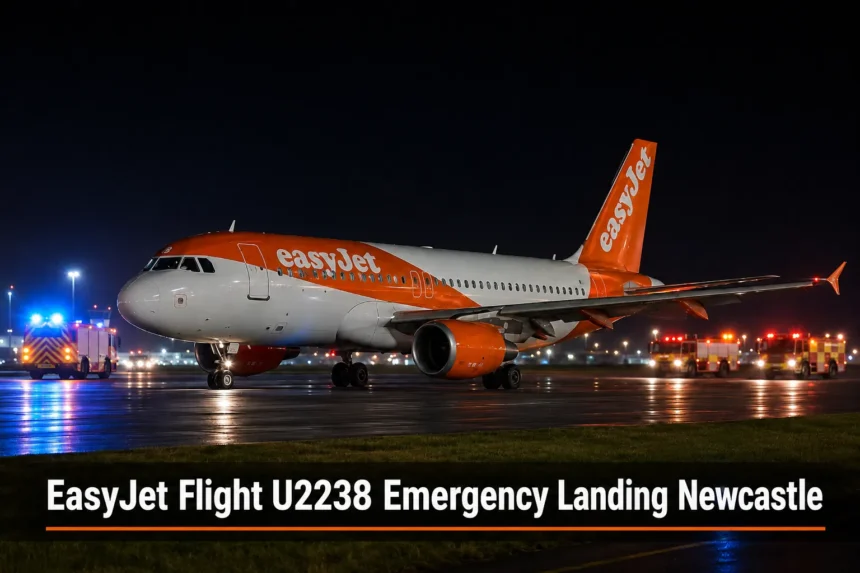
On the night of 27 October 2025, EasyJet flight U2238 made an emergency landing at Newcastle International Airport after a passenger became seriously ill mid-flight. The scheduled Copenhagen-to-Manchester service diverted roughly 40 minutes before its original destination, triggering a coordinated response across air traffic control, airport ground teams, and NHS emergency services.
- What Was EasyJet Flight U2238 — Route, Aircraft, and the Night It Diverted
- The Medical Emergency That Triggered the EasyJet Flight U2238 Emergency Landing at Newcastle
- Squawk 7700, Pan-Pan, and Mayday — The Emergency Signals Most People Confuse
- Why Newcastle and Not Manchester — The Decision Logic at 38,000 Feet
- The 40-Minute Window — A Minute-by-Minute Reconstruction
- What Most People Get Wrong About Emergency Landings
- What Happened to the Passenger — and What easyJet Said Publicly
- Your Rights as a Passenger When a Flight Is Diverted for an Emergency
- Conclusion
- Frequently Asked Questions
- Q: What caused the EasyJet Flight U2238 emergency landing at Newcastle?
- Q: Is U2238 the same flight as EZY2238 and U22238?
- Q: Was there anything mechanically wrong with the aircraft?
- Q: What is the difference between a Pan-Pan and a Mayday declaration?
- Q: Can passengers claim compensation when a flight diverts for a medical emergency?
- Q: What happened to the passenger taken ill on Flight U2238?
- Q: What should passengers do if their flight makes an emergency landing?
- Q: How common are medical emergency landings in commercial aviation?
Many passengers and observers still have unanswered questions — what actually happened, whether the flight code is correct, and what rights they held. This article covers the verified incident timeline, the emergency systems activated, why Newcastle was selected, and exactly what compensation rules apply when a diversion is classified as an extraordinary circumstance.
What Was EasyJet Flight U2238 — Route, Aircraft, and the Night It Diverted
Flight U2238 operated on an Airbus A320-214, registered as G-EZPB, which had been in continuous easyJet service since February 2016. On 27 October 2025, it carried 178 passengers and 6 crew members — filling 178 of 180 available seats — on a standard Copenhagen (CPH) to Manchester (MAN) crossing.
The aircraft pushed back from Copenhagen at 22:13 local time, 28 minutes behind its 21:45 scheduled departure. Nothing about the aircraft or route indicated an unusual night ahead. G-EZPB had no reported technical issues before or after the incident.
Why U2238, EZY2238, and U22238 All Refer to the Same Flight
EasyJet uses “U2” as its IATA airline code on tickets and booking systems, while operational radar networks display the designator “EZY.” This means U2238, EZY2238, and U22238 all identify the same Copenhagen-to-Manchester service.
A separate easyJet route between Newcastle and Bristol carries a similar code, which caused factual errors in early reporting. The 27 October diversion involved only the Copenhagen-to-Manchester flight.
The Medical Emergency That Triggered the EasyJet Flight U2238 Emergency Landing at Newcastle
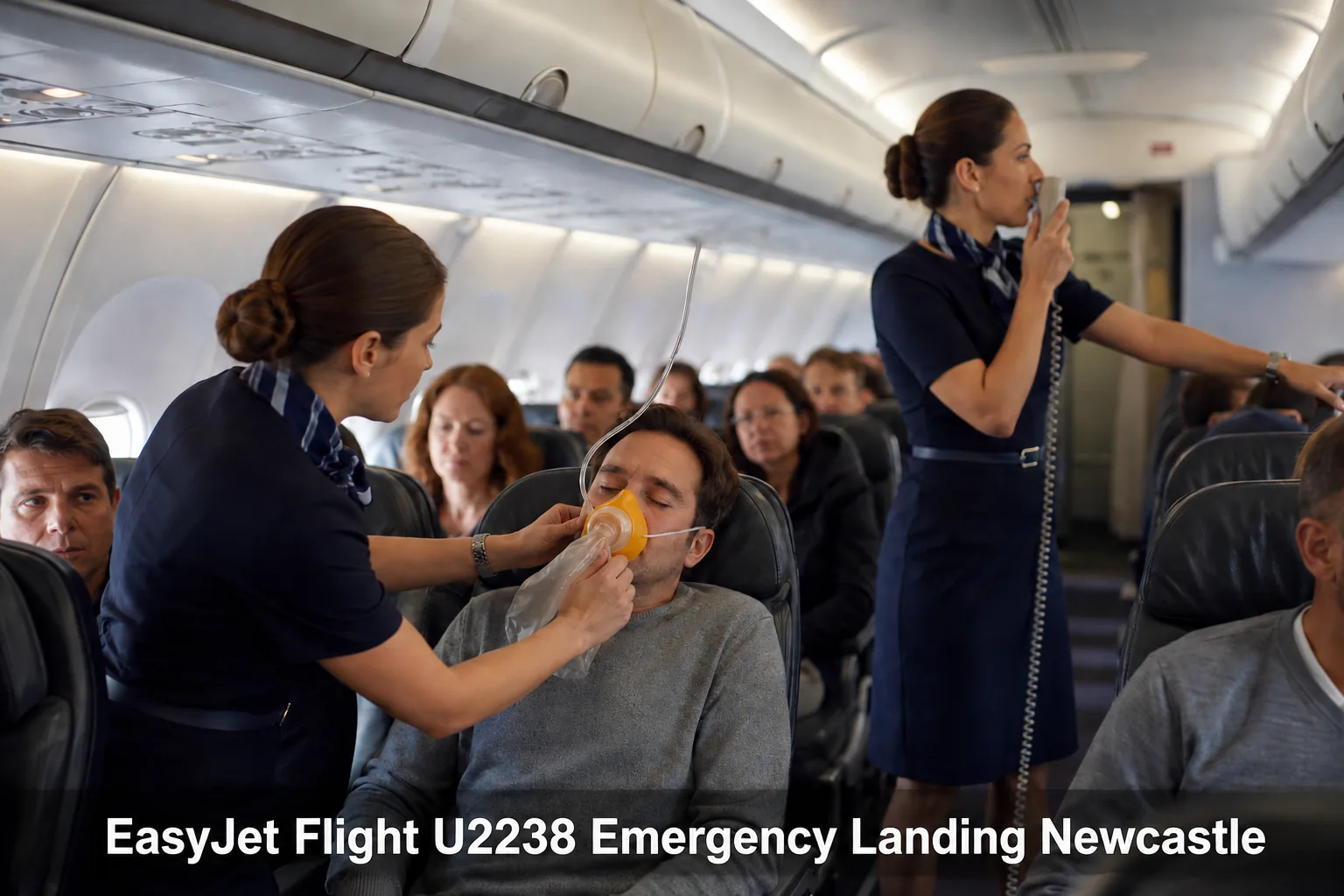
Roughly 15 minutes after takeoff, while G-EZPB was still climbing over the North Sea, a passenger’s condition deteriorated rapidly. Initial symptoms progressed to breathing difficulties and physical weakness — serious enough that waiting until Manchester was not an option.
Cabin crew are trained first responders under EASA regulations, not simply service staff. In my experience reviewing aviation incident reports, the speed of crew escalation in the first five minutes is the single biggest determinant of passenger outcomes in airborne medical emergencies. Here, the crew moved immediately: onboard medical kit deployed, oxygen support administered, flight deck informed.
How the Cabin Crew Responded Before the Pilots Were Involved
EASA CS-FCD regulations mandate that all commercial cabin crew hold certified first aid competency, with recurrent training cycles covering CPR, oxygen administration, and crew resource management. The U2238 crew followed this protocol precisely — assessing severity, stabilizing the passenger, checking for medically trained individuals on board, and communicating a clear picture to the pilots. That structured escalation is what gave the captain the information needed to make a diversion call without hesitation.
Squawk 7700, Pan-Pan, and Mayday — The Emergency Signals Most People Confuse
At approximately 21:28 UTC, the captain set the aircraft’s transponder to Squawk 7700 — the ICAO-designated four-digit code for a general aviation emergency. The moment that code was transmitted, UK Air Traffic Control received automatic notification, and other aircraft in the area began receiving rerouting instructions.
Squawk 7700 is distinct from the verbal declarations pilots also use. A Pan-Pan call signals urgency — a serious situation that requires priority handling but does not yet pose immediate danger to life or aircraft. A Mayday signals distress — immediate danger requiring urgent assistance.
In a medical diversion of this type, Pan-Pan is the standard declaration; Mayday is reserved for imminent aircraft or mass-casualty emergencies. The Squawk 7700 code supports whichever verbal declaration is made, ensuring ATC systems respond automatically regardless of voice communication clarity.
Why Newcastle and Not Manchester — The Decision Logic at 38,000 Feet
The “nearest suitable airport” doctrine does not mean nearest airport. Pilots assess runway length, emergency service availability, weather, 24-hour operational status, and — critically — pre-positioning time for ground medical teams. Newcastle International Airport met every criterion at the moment the emergency was declared.
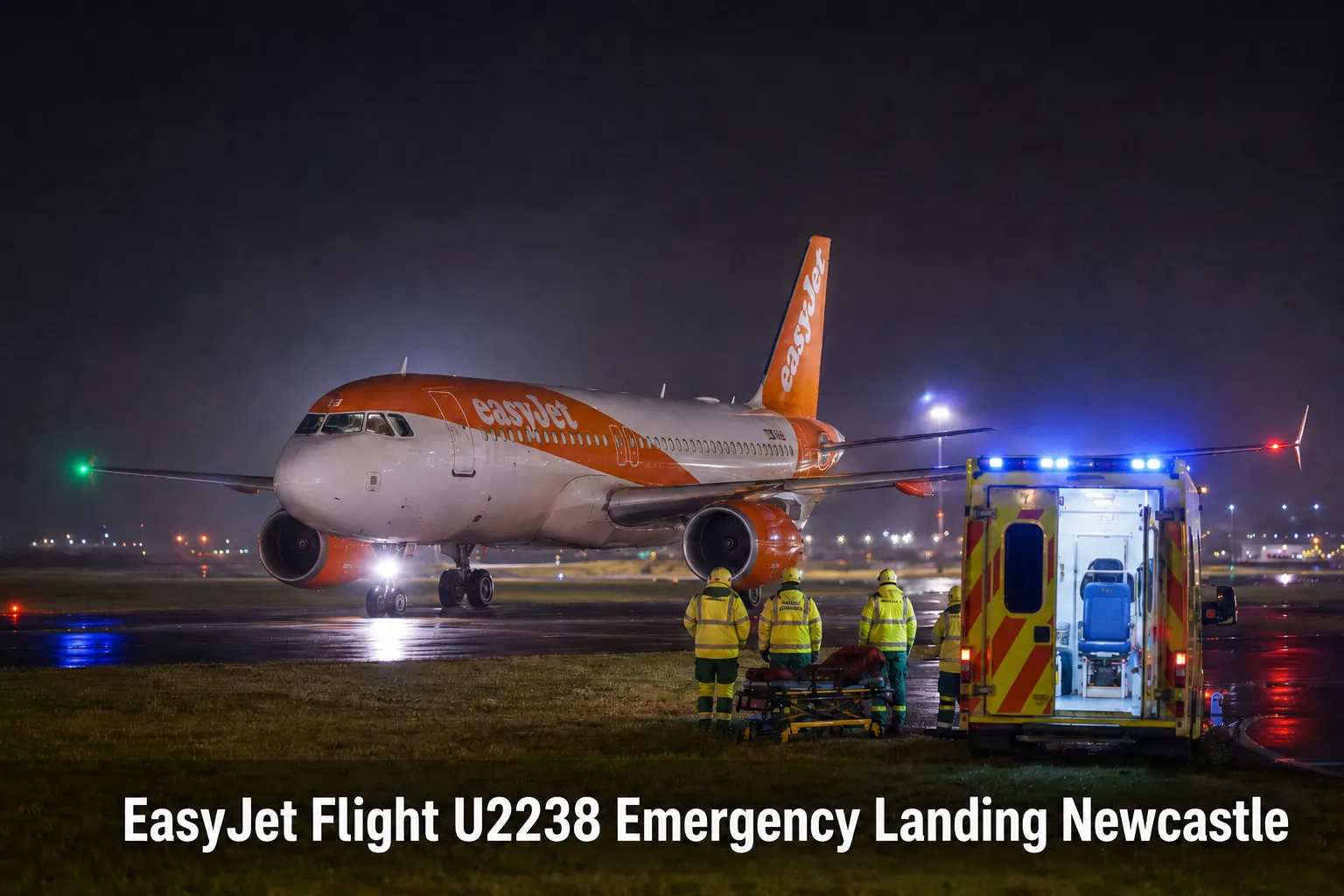
Manchester was still approximately 40 minutes away. Continuing would have cost time that could not be recovered. By 22:33 GMT, Newcastle’s operations team had already alerted the North East Ambulance Service. The aircraft touched down at approximately 22:52–22:54 GMT. NEAS paramedics were positioned at the runway before the wheels made contact.
The Royal Victoria Infirmary — a Level 1 major trauma centre with one of the strongest emergency departments in the north of England — is minutes from the airport. That proximity was part of the calculation.
How Air Traffic Control Cleared the Path in Real Time
Once Squawk 7700 was set and the crew declared their intention to divert, NATS (National Air Traffic Services) issued priority routing and priority descent clearance to EZY2238. Surrounding traffic was held or rerouted. Newcastle Airport operations coordinated directly with NEAS, ensuring a clear runway approach and ground positioning.
According to ICAO Annex 2 procedures, all of this coordination happens through standardized phraseology and pre-established multi-agency protocols, which is why it appears seamless even at night with no warning.
The 40-Minute Window — A Minute-by-Minute Reconstruction
| Time (UTC/GMT) | Event |
| 21:13 UTC | Departure from Copenhagen (22:13 local) |
| ~21:28 UTC | Squawk 7700 activated; ATC notified |
| ~22:33 GMT | Newcastle Airport and NEAS are placed on standby |
| 22:52–22:54 GMT | G-EZPB lands at Newcastle International |
| ~23:00 GMT | NEAS paramedics board; passenger transferred |
| ~23:00–00:02 GMT | G-EZPB on ground; post-incident inspection |
| 00:02 GMT (28 Oct) | EZY2238 departs Newcastle for Manchester |
| 00:28 GMT | Aircraft lands at Manchester Airport |
From emergency declaration to hospital-level care: approximately 40 minutes. The aircraft was back in service the same night, confirming no technical faults on G-EZPB.
What Most People Get Wrong About Emergency Landings
An emergency landing does not mean something went wrong with the plane. G-EZPB underwent a mandatory post-incident technical inspection at Newcastle and was cleared with no faults found. The diversion was entirely medical.
According to the Aviation Medical Assistance Act framework and ICAO safety classifications, medical diversions fall under precautionary emergency — a structured, controlled response, not a distress event. According to data compiled by the Aerospace Medical Association (ASMA), medical incidents occur on approximately 1 in every 604 commercial flights. The fact that diversions happen regularly is evidence of the system working correctly, not failing.
The frequency of successful medical diversions is proof that aviation safety protocols function exactly as designed.
What Happened to the Passenger — and What easyJet Said Publicly
The affected passenger was transferred directly from G-EZPB to NEAS care upon landing and taken to the Royal Victoria Infirmary in Newcastle. Neither easyJet, NEAS, nor Newcastle Hospitals NHS Trust disclosed the patient’s identity or diagnosis — standard practice under NHS confidentiality rules for all emergency admissions.
EasyJet’s official statement read: “Flight EZY2238 from Copenhagen to Manchester on 27 October diverted to Newcastle, due to a customer onboard requiring urgent medical attention. The customer was met by medical services on arrival, and the flight continued to Manchester. The safety and well-being of our customers and crew is always easyJet’s highest priority.”
No follow-up reports indicated a fatal outcome. The airline’s statement confirmed the passenger received timely care, which, given the speed of landing and hospital transfer, represents the best possible result the system could deliver.
Your Rights as a Passenger When a Flight Is Diverted for an Emergency
EZY2238 arrived at Manchester approximately 1 hour and 43 minutes late. Under UK261 — the UK’s post-Brexit air passenger rights regulation, aligned with but now distinct from EU Regulation 261/2004 — compensation is triggered only when delays exceed three hours at the final destination. The 1hr 43min delay fell below that threshold.
Even if the delay had exceeded three hours, the medical emergency classification as an extraordinary circumstance beyond the airline’s control removes the financial compensation obligation entirely. Extraordinary circumstances cover events that could not have been prevented even with all reasonable measures — a spontaneous passenger medical emergency qualifies unambiguously.
What About Connecting Flights, Luggage, and Hotel Costs After a Diversion?
Extraordinary circumstances remove compensation liability, but it does not remove duty of care obligations. Under UK CAA guidance, airlines must still provide meals, refreshments, and hotel accommodation if passengers are stranded overnight. Luggage remains with the aircraft and travels to the final destination.
Passengers who missed onward connections should submit out-of-pocket expense claims directly to easyJet, retaining all receipts. Travel insurance policies with trip disruption cover typically reimburse costs the airline does not.
Conclusion
The EasyJet flight U2238 emergency landing at Newcastle on 27 October 2025 was handled exactly as aviation safety systems are designed to handle it — cabin crew escalated quickly, the captain made the right call, ATC cleared the airspace, and NEAS had paramedics at the runway before the aircraft stopped. Every layer of the system worked. The aircraft was back in service the same night. The passenger reached a Level 1 trauma centre within 40 minutes of the emergency being declared.
The most important thing this incident demonstrates is that emergency landings are not failures — they are the safety net functioning correctly. A diversion is the system catching a problem before it becomes a tragedy.
If you were on EZY2238 and need to submit an expense claim for disruption costs, contact easyJet’s customer service directly with your booking reference and receipts. If you want to understand your rights on any future diverted flight, bookmark the UK Civil Aviation Authority’s passenger rights guidance at caa.co.uk.
Frequently Asked Questions
Q: What caused the EasyJet Flight U2238 emergency landing at Newcastle?
A: A passenger onboard became seriously ill approximately 15 minutes after departure from Copenhagen, requiring immediate medical attention. The captain declared an emergency and diverted to Newcastle, the closest suitable airport with full emergency services available.
Q: Is U2238 the same flight as EZY2238 and U22238?
A: Yes. EasyJet uses “U2” as its IATA code on schedules and tickets, while radar systems display “EZY.” All three codes — U2238, EZY2238, U22238 — refer to the same Copenhagen-to-Manchester service that diverted on 27 October 2025.
Q: Was there anything mechanically wrong with the aircraft?
A: No. Post-landing technical inspections on G-EZPB confirmed no faults. The diversion was caused entirely by the medical emergency onboard, not any issue with the Airbus A320-214 aircraft.
Q: What is the difference between a Pan-Pan and a Mayday declaration?
A: Pan-Pan signals urgency — a serious situation requiring priority handling. Mayday signals immediate distress and danger to life. Medical diversions typically involve a Pan-Pan declaration. Both are supported by activating Squawk 7700 on the transponder.
Q: Can passengers claim compensation when a flight diverts for a medical emergency?
A: Generally, no. Under UK261, a medical diversion qualifies as an extraordinary circumstance, removing the airline’s compensation obligation. The EZY2238 delay of 1hr 43min also fell below the three-hour threshold independently required to trigger a claim.
Q: What happened to the passenger taken ill on Flight U2238?
A: The passenger was transferred to the Royal Victoria Infirmary in Newcastle by the North East Ambulance Service. Under NHS confidentiality rules, no medical details were disclosed. No reports indicated a fatal outcome following treatment.
Q: What should passengers do if their flight makes an emergency landing?
A: Follow cabin crew instructions immediately and remain seated until directed otherwise. Crew is trained first responders — cooperating with them directly supports both the medical response and the safety of everyone on board.
Q: How common are medical emergency landings in commercial aviation?
A: According to the Aerospace Medical Association, medical incidents occur on approximately 1 in 604 commercial flights globally. Cardiac events, respiratory distress, and loss of consciousness are the most frequent causes. Successful diversions like U2238 are far more common than the public realizes.