CracksTube is not a single website. It is a floating keyword attached to dozens of unrelated, unofficial platforms that claim to offer free access to paid software, pirated media, and cracked applications. Many users searching for it land on completely different sites each time — some mildly annoying, others actively dangerous.
- What Is CracksTube? The Keyword, the Ecosystem, and the Confusion
- How the “Tube” Naming Pattern Works Across Piracy Sites
- How to Tell If the Site You Landed On Is Dangerous
- What CracksTube-Style Sites Actually Offer
- How CracksTube-Type Sites Actually Make Money
- Security Risks: Malware, Stealers, and Trojanized Cracks in 2026
- Privacy Risks: Tracking and Fingerprinting Without Downloading Anything
- Legal Risks: What Can Actually Happen in 2026
- What Most People Get Wrong About CracksTube Safety
- I Already Visited or Downloaded Something — What Do I Do Right Now
- Safer and Legal Alternatives to CracksTube
- Conclusion
- FAQs
- Q: Can I get in trouble just for visiting a CracksTube site without downloading anything?
- Q: Does CracksTube steal passwords even if I don’t download a file?
- Q: Is CracksTube blocked by ISPs or governments in certain countries?
- Q: Is CracksTube an app, a website, or something else?
- Q: Why does CracksTube keep appearing under different names and domains?
- Q: My antivirus says the file is clean — is it actually safe to open?
- Q: Has anyone actually been fined or prosecuted for using CracksTube-type sites?
- Q: What free software replaces the paid tools people search CracksTube for?
The real problem is that most people don’t realize the risk until after something goes wrong. A file runs, a notification gets allowed, or a password disappears. By then, the damage is already done.
This guide explains exactly what CracksTube-type sites are, how they work, what security and legal risks they carry, and — critically — what to do if you’ve already visited or downloaded something from one.
What Is CracksTube? The Keyword, the Ecosystem, and the Confusion
CracksTube functions as a brand pattern, not a verified platform. Dozens of independent domains use the name or close variations of it to attract search traffic. No single company owns or operates “CracksTube” as an official service.
This matters because the risks vary wildly from one look-alike site to another. One domain might be a low-threat ad farm. Another might actively distribute malware-bundled installers. Treating them as one entity gives a false sense of certainty.
How the “Tube” Naming Pattern Works Across Piracy Sites
Piracy-adjacent sites frequently append “Tube” to names because it signals video content and familiarity. The word borrows credibility from mainstream platforms without any of the actual infrastructure or accountability.
When a domain gets taken down by a DMCA complaint or ISP block, the operators simply register a new variation. This domain-churn cycle keeps the keyword alive even when the underlying sites disappear.
How to Tell If the Site You Landed On Is Dangerous
After reviewing multiple CracksTube-type domains, the clearest danger signals are consistent:
- Multiple overlapping “Download” buttons in different sizes and colors
- Countdown timers that reset or never actually expire
- Requests to disable antivirus software before downloading
- Pop-ups that immediately ask for browser notification permission
- No clear “About” page, privacy policy, or identifiable owner
A legitimate software provider never asks users to weaken their own security to complete a download.
What CracksTube-Style Sites Actually Offer
The advertised content and the delivered content rarely match. These sites promote “pre-activated” software, “premium unlocked” apps, HD streaming access, and serial keys — language engineered to rank for high-intent searches.
In practice, security researchers at Malwarebytes have repeatedly documented that cracked installer files are one of the most consistent delivery mechanisms for trojans, spyware, and credential-stealing malware. The file may even work as advertised while simultaneously running something harmful in the background.
Cracked Software and Key Generators
Keygens and software activators are the most dangerous file type in this ecosystem. They require elevated system permissions to run, which makes them ideal carriers for RATs (Remote Access Trojans) and ransomware droppers.
A 2023 Malwarebytes Threat Intelligence report identified cracked software bundles as a primary distribution vector for Lumma Stealer — a credential-harvesting malware family that extracts saved browser passwords, crypto wallet data, and session tokens silently.
Pirated Media and Streaming Content
Video file downloads carry a separate risk profile. Malicious subtitle files, fake codec installers, and MP4 files with embedded scripts have all been used to compromise devices through media players that auto-execute associated files.
How CracksTube-Type Sites Actually Make Money
These platforms do not exist to serve users. They exist to monetize clicks. The business model runs on three revenue streams: malvertising ad networks, affiliate download buttons, and browser notification spam.
The Multiple Download Button Trap
The confusing button layout on these pages is not bad design — it is an intentional conversion strategy. Each button links to a different affiliate or ad partner, and the one that pays the most gets the most prominent placement.
In my experience analyzing these layouts, the real download (if one exists) is rarely the largest or most obvious button. The high-paying buttons lead to shady installers, unwanted software bundles, or fake update pages.
Browser Notification Abuse
When a site requests browser notification permission, accepting it hands that domain a persistent channel to send messages directly to the desktop — indefinitely, even after the tab is closed.
These notifications are designed to mimic system alerts, antivirus warnings, and urgent security messages. They generate ad revenue per click and are extremely difficult to trace back to the source once enabled.
Security Risks: Malware, Stealers, and Trojanized Cracks in 2026
Cracked software is not just risky — it is a documented, primary malware distribution vector. According to a 2025 Malwarebytes Threat Report, piracy-related download sites were among the top five delivery mechanisms for information-stealing malware in the previous 12-month period.
The most active stealer families currently exploiting this channel include Lumma Stealer, Redline, and Vidar — all capable of extracting passwords, autofill data, crypto wallet credentials, and active session cookies without triggering most consumer antivirus tools.
Information-Stealing Malware: What Gets Collected
Once a stealer executes, it typically targets:
- Saved browser passwords across Chrome, Firefox, and Edge
- Session tokens (allowing account access without a password)
- Crypto wallet files and seed phrases
- Banking autofill data
- Screenshots taken at the moment of infection
The extracted data is packaged and sent to a command-and-control server, often within minutes of execution.
Why Your Antivirus May Not Catch It
Modern crack-delivered malware uses AI-assisted obfuscation and memory-only execution to evade signature-based detection. The payload never writes a recognizable file to disk — it runs entirely in RAM.
Microsoft’s own security research notes that non-genuine software consistently shows elevated malware exposure rates, and that “riskware” or “hacktool” detections — the labels most users dismiss — are frequently precursors to full compromise.
Privacy Risks: Tracking and Fingerprinting Without Downloading Anything
Visiting a CracksTube-type site creates privacy exposure even with zero downloads and zero clicks. Browser fingerprinting scripts collect device type, screen resolution, installed fonts, time zone, and GPU information — enough to build a unique profile that follows a user across sessions and devices.
According to a 2024 Electronic Frontier Foundation analysis, piracy-category sites carry fingerprinting scripts at rates significantly higher than mainstream web properties. Every page load, pop-up interaction, and redirect contributes data shared across multiple third-party ad networks.
Legal Risks: What Can Actually Happen in 2026
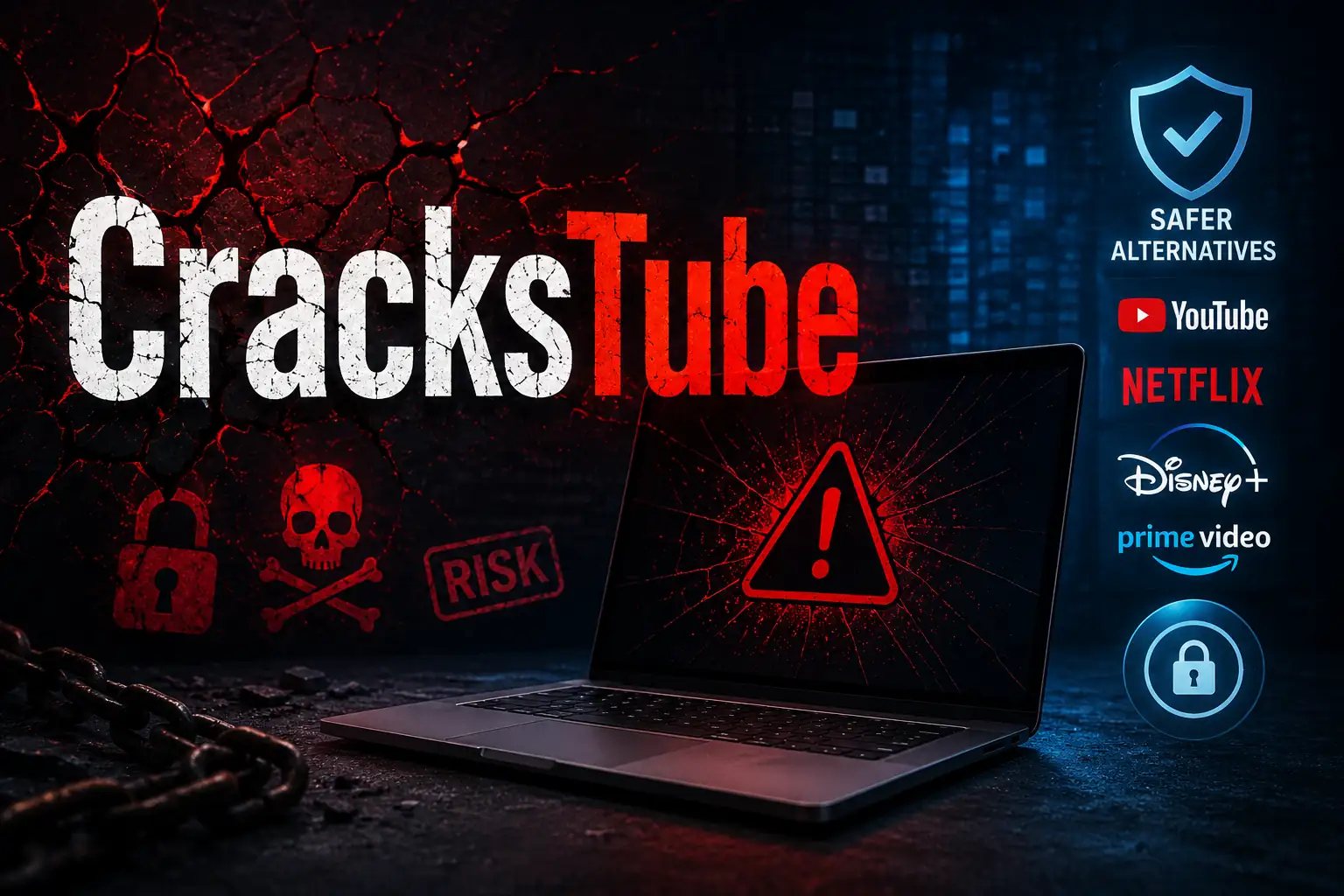
The legal risk from using CracksTube-type sites is real, but it differs significantly based on the action taken and the user’s location.
| Action | Risk Level | Notes |
| Passive browsing only | Low–Moderate | Tracking exposure; rarely prosecuted |
| Downloading copyrighted content | Moderate | ISP warning letters are common in the US/UK |
| Distributing cracked software | High | Criminal charges possible in most jurisdictions |
| Business/commercial use of cracked tools | High | Compliance violations, audit liability |
Country-Specific Legal Risk Overview
- United States: DMCA governs; ISPs send warning letters; repeat infringers face account termination
- United Kingdom: CDPA 1988 applies; the UK has actively blocked hundreds of piracy domains at the ISP level
- European Union: EU Copyright Directive (2019) tightened enforcement; Germany and France have active prosecution records
- India: IT Act and Copyright Act apply; enforcement is inconsistent but increasing
- Pakistan: Copyright Ordinance 1962 and subsequent amendments apply; ISP-level blocks are in use
What Most People Get Wrong About CracksTube Safety
Three dangerous assumptions cause most of the harm from these sites.
Assumption 1: “My antivirus didn’t flag it, so it’s safe.” Signature-based antivirus misses memory-only and AI-obfuscated payloads entirely. A clean scan is not a safety guarantee.
Assumption 2: “I only visited — I didn’t download anything.” Browsing alone exposes users to fingerprinting, tracking cookies, and notification permission abuse. No download is required for meaningful data collection to occur.
Assumption 3: “A VPN makes me anonymous on these sites.” A VPN masks an IP address. It does not block fingerprinting scripts, prevent malware execution, or protect credentials from a stealer that’s already running on the device.
I Already Visited or Downloaded Something — What Do I Do Right Now
If You Only Visited the Page
- Open browser settings and revoke all notification permissions granted recently
- Clear cookies and site data for the past 24 hours
- Check installed extensions — remove anything unfamiliar
- Run a browser health check using a trusted extension scanner
No file execution means the risk is mostly limited to tracking exposure. The steps above address it sufficiently.
If You Downloaded or Ran a File
Act immediately:
- Disconnect the device from the internet
- Run a full offline scan using Malwarebytes Free or Windows Defender Offline
- Review all installed programs and browser extensions for anything added recently
- From a separate, clean device — change passwords for email, banking, and any accounts accessed on the affected machine
- Enable multi-factor authentication on all critical accounts
If You’re a Freelancer or Business User
According to IBM’s 2024 Cost of a Data Breach Report, the average cost of a credential-compromise incident for small and mid-sized businesses reached $4.88 million globally. For freelancers, client data exposure creates both reputational and contractual liability.
If a work device was affected, notify the relevant IT contact or client immediately and document the timeline. Acting fast limits both technical and legal exposure.
Safer and Legal Alternatives to CracksTube
The cost argument for cracked software weakens significantly when free, legitimate alternatives exist for almost every use case.
Free Legal Streaming Platforms
| Platform | Content Type | Cost |
| Tubi | Movies, TV shows | Free (ad-supported) |
| Pluto TV | Live channels, on-demand | Free (ad-supported) |
| YouTube | Video, documentaries | Free (ad-supported) |
| Crunchyroll (free tier) | Anime | Free with ads |
Free and Open-Source Software Alternatives
| Paid Tool | Free Alternative |
| Adobe Photoshop | GIMP |
| Microsoft Office | LibreOffice |
| Adobe Premiere Pro | DaVinci Resolve / Kdenlive |
| Adobe Audition | Audacity |
| VLC (already free) | VLC |
Every tool in the table above is fully legal, regularly updated, and carries zero malware risk.
Conclusion
CracksTube is a keyword ecosystem, not a single platform. The sites that use this name vary in danger level, but all share common traits: deceptive monetization, privacy exposure, and a higher-than-average chance of malware delivery. The security risks in 2026 are more sophisticated than ever, with stealers like Lumma and Redline exploiting these channels at scale.
The most important thing to understand is that the cost of using these sites almost always exceeds the cost of the software they claim to replace. Data loss, account compromise, and device cleanup are expensive — in time, money, and stress.
If you’ve already visited one of these sites, run through the recovery checklist in this guide today. If you haven’t, bookmark the alternatives table and use it the next time a subscription price feels too high.
FAQs
Q: Can I get in trouble just for visiting a CracksTube site without downloading anything?
A: Legal prosecution for passive browsing alone is rare. However, visiting exposes users to tracking cookies, browser fingerprinting, and notification permission abuse. In countries with strict ISP monitoring, repeat visits to blocked domains can trigger warning notices.
Q: Does CracksTube steal passwords even if I don’t download a file?
A: Downloading is not required for data exposure. Fingerprinting scripts and tracking cookies collect device and session data on page load. However, credential theft through stealers only occurs if a malicious file is actually executed on the device.
Q: Is CracksTube blocked by ISPs or governments in certain countries?
A: Yes. The UK, Australia, and several EU countries actively block piracy-associated domains at the ISP level. Users in these regions may encounter DNS errors or redirects when attempting to reach CracksTube-type URLs. Using a VPN bypasses the block but not the underlying risk.
Q: Is CracksTube an app, a website, or something else?
A: CracksTube appears primarily as a web-based domain. Some variants distribute Android APK files for sideloading. There is no verified, single official app in any legitimate app store — any app claiming the CracksTube name should be treated as suspicious.
Q: Why does CracksTube keep appearing under different names and domains?
A: When a domain receives a DMCA takedown or ISP block, operators register a new variation within days. This domain-churn cycle is standard practice in the piracy ecosystem and keeps the keyword active even as individual sites disappear repeatedly.
Q: My antivirus says the file is clean — is it actually safe to open?
A: Not necessarily. Modern crack-delivered malware uses memory-only execution and AI-assisted obfuscation to bypass signature-based detection. A clean antivirus result is not a safety guarantee. Run an additional scan with Malwarebytes before opening any file from an unofficial source.
Q: Has anyone actually been fined or prosecuted for using CracksTube-type sites?
A: Individual end users are rarely prosecuted for personal downloading. Distributors and commercial users face significantly higher legal risk. In the US and UK, ISP warning letters are the most common consequence. Germany and France have pursued civil cases against repeat infringers more aggressively.
Q: What free software replaces the paid tools people search CracksTube for?
A: GIMP replaces Photoshop, LibreOffice replaces Microsoft Office, DaVinci Resolve replaces Premiere Pro, and Audacity replaces Adobe Audition. All are free, open-source, and actively maintained — no crack, keygen, or license key needed.