
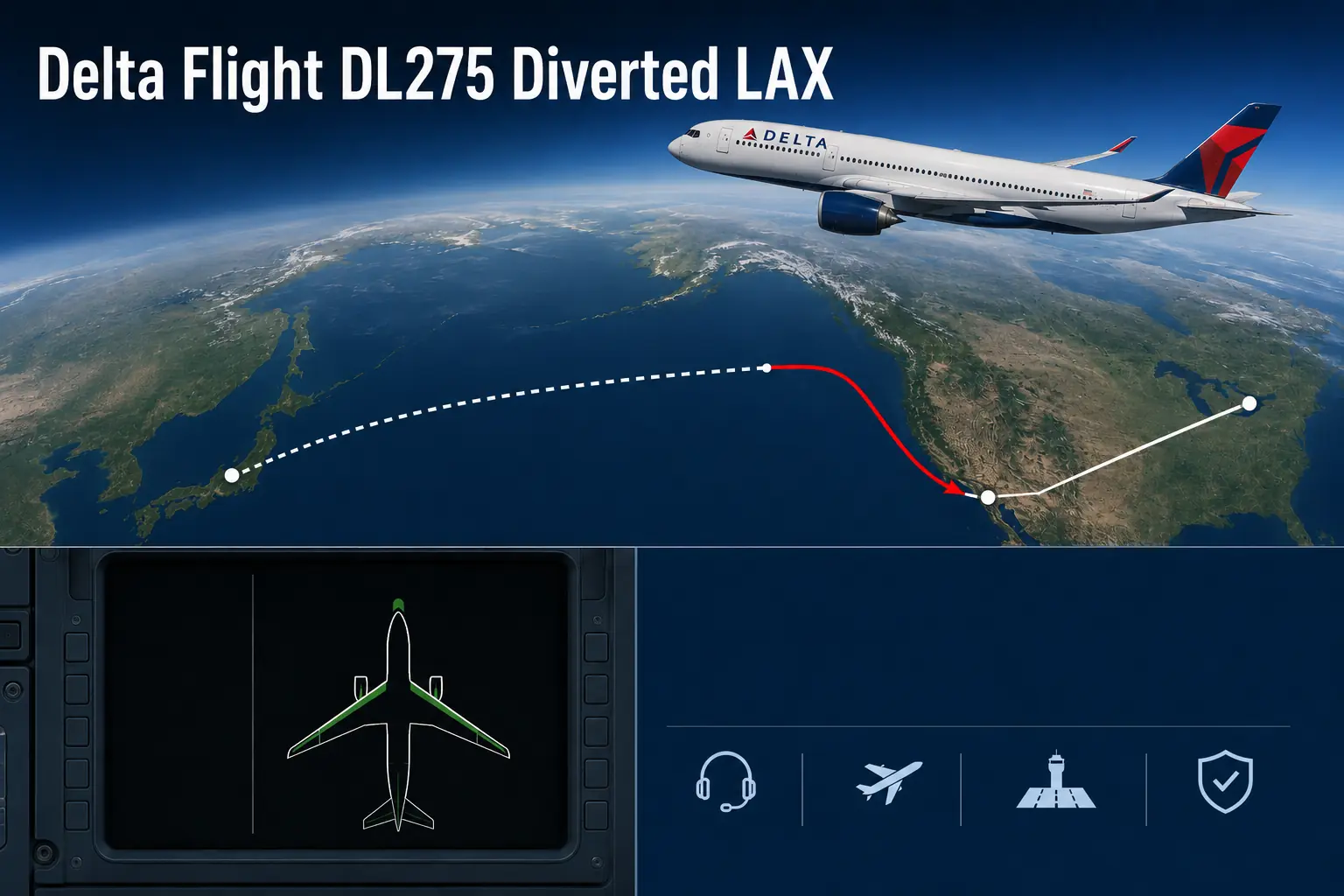
Delta flight DL275 diverted to LAX on May 28, 2025, after a critical engine anti-ice system fault forced the crew to abandon a routine Detroit-to-Tokyo transpacific crossing over the Bering Sea. All 287 passengers landed safely. No emergency was declared.
- What Actually Happened on Delta Flight DL275 — The Verified Timeline
- What an Engine Anti-Ice System Actually Does — And Why This Fault Forced a Diversion
- What a System Anomaly Looks Like in the Cockpit
- Why This Fault Is More Dangerous Over an Ocean Than Over Land
- ETOPS — The Real Reason LAX Was Chosen Over Anchorage
- What does ETOPS Certification require of the Diversion Airport?
- Why Anchorage Did Not Qualify for This Specific Diversion
- What Most People Get Wrong About the DL275 Diversion
- What Nobody Told You About Your Bags, Your Rights, and Your Money
- What Happens to Your Checked Bags When a Flight Diverts Mid-Pacific
- What Delta Was Legally Required to Provide
- Compensation Beyond the Basics — Missed Hotels, Tours, and Business Losses
- What Happened After Landing — N508DN’s Grounding and Return to Service
- Conclusion
- FAQs
- Q: Is an engine anti-ice system failure the same as an engine failure — was DL275 in danger?
- Q: Why was Los Angeles chosen over Anchorage, which is much closer to where the alert occurred?
- Q: Was a mayday or emergency declared on Delta flight DL275, diverted to LAX?
- Q: What happened to checked bags for DL275 passengers during the LAX overnight stop?
- Q: Was there an NTSB investigation opened into the DL275 diversion?
- Q: What compensation are passengers on a diverted international flight legally entitled to beyond hotel and meals?
- Q: Is the Rolls-Royce Trent XWB anti-ice system a known recurring problem on the A350?
- Q: Is Delta Flight DL275 still operating the Detroit–Tokyo Haneda route?
Most passengers and readers walk away from this story with three wrong assumptions: that an engine was failing, that Los Angeles was a convenient choice, and that hotel vouchers are the limit of what airlines owe. All three are incorrect.
This article covers the verified timeline, the technical cause explained clearly, why ETOPS certification — not hub preference — drove the LAX decision, what passengers were legally owed, and what happened to N508DN after landing.
What Actually Happened on Delta Flight DL275 — The Verified Timeline
DL275 departed Detroit Metropolitan Wayne County Airport (DTW) from Gate A46 at 15:53 local time on May 27, 2025. The flight was already slightly delayed due to a late inbound aircraft from an Amsterdam rotation.
For the first six hours, everything was normal. The Airbus A350-900, registration N508DN, climbed to 38,000 feet and tracked northwest across the North Pacific toward Tokyo Haneda (HND).
The Moment the ECAM Alert Fired Over the Bering Sea
Approximately six hours into the flight, the Electronic Centralized Aircraft Monitor (ECAM) flagged an anomaly in the anti-ice system of one Rolls-Royce Trent XWB engine. The aircraft was roughly 620 nautical miles southwest of Anchorage, Alaska, deep over remote oceanic airspace with no nearby suitable diversion airport.
The crew assessed the fault through standard abnormal operations checklists. Bleed-air pressure readings confirmed the system was not behaving within certified parameters. At that altitude and position, the crew made the correct call: divert rather than continue across eight more hours of open Pacific.
The Turn, the Descent, and the LAX Landing
The aircraft executed a course reversal over the Pacific and tracked southeast toward California. After a five-hour diversion leg, N508DN touched down on Runway 06R at Los Angeles International Airport at approximately 01:08 AM on May 28, 2025 — 12 hours and 15 minutes after departure.
FlightAware and Flightradar24 ADS-B transponder data confirm the course deviation clearly in N508DN’s flight path record. Emergency services were standing by on the ground. There were zero injuries.
What an Engine Anti-Ice System Actually Does — And Why This Fault Forced a Diversion
The anti-ice system failure and an engine failure are not the same thing. This distinction is the most commonly misunderstood aspect of the DL275 incident.
At cruising altitude, outside air temperatures reach -50°C. Without active thermal protection, ice accumulates on fan blades, engine inlets, and aerodynamic surfaces. The Rolls-Royce Trent XWB addresses this by routing heated bleed air — drawn from the engine’s compressor at between 400°F and 600°F — across vulnerable surfaces continuously during flight.
What a System Anomaly Looks Like in the Cockpit
When the anti-ice system malfunctions, the ECAM displays a caution or warning alert depending on fault severity. The crew receives a status page showing which system has deviated, accompanied by an abnormal checklist.
The checklist does not instruct the crew to shut down the engine. It instructs them to assess the fault, monitor system behavior, and evaluate whether continued flight is within certified safety margins — particularly over terrain or airspace where a single-engine diversion airport is accessible within ETOPS time limits.
Why This Fault Is More Dangerous Over an Ocean Than Over Land
Over land, a degraded anti-ice system carries a manageable risk because diversion airports are minutes away. Over the North Pacific, the nearest ETOPS-qualified alternate airport is hours away by air.
Continuing with a confirmed bleed-air anomaly through eight more hours of icing-condition altitude, with no viable diversion point if conditions worsened, fell outside conservative diversion criteria. The crew’s decision to divert was textbook protocol — not an overreaction.
ETOPS — The Real Reason LAX Was Chosen Over Anchorage
ETOPS (Extended-Range Twin-Engine Operational Performance Standards) is the FAA and ICAO certification framework that governs transoceanic twin-engine flight. The Airbus A350-900 holds ETOPS-330 approval on this route, meaning every alternate airport on the flight plan must be reachable within 330 minutes on a single engine — and must meet specific maintenance and infrastructure requirements.
Anchorage feels like the obvious choice. It is closer. But proximity is only one part of the ETOPS alternate airport qualification.
What does ETOPS Certification require of the Diversion Airport?
For a diversion airport to qualify under ETOPS for a specific aircraft type and fault condition, it must have:
- Certified maintenance capability for that aircraft type
- Parts inventory for the affected system (in this case, Trent XWB anti-ice components)
- 24/7 qualified technician availability
- Documented infrastructure agreement with the operating airline
LAX meets all four criteria for the A350-900 and Rolls-Royce Trent XWB. Delta operates a major maintenance hub at LAX with round-the-clock Rolls-Royce support and certified spare parts inventory for the Trent XWB engine family.
Why Anchorage Did Not Qualify for This Specific Diversion
Ted Stevens Anchorage International Airport does not maintain A350-certified Trent XWB maintenance infrastructure at the level ETOPS mandates for this fault category. LAX was not chosen for passenger convenience. It was the nearest ETOPS-compliant airport with the specific technical capability this fault required.
What Most People Get Wrong About the DL275 Diversion
Three misconceptions dominate coverage of this event.
Misconception 1: An engine was failing. The Trent XWB engine continued operating. The anti-ice system — one subsystem within the engine’s broader architecture — generated an anomalous sensor reading. These are categorically different events.
Misconception 2: This was an emergency landing. No mayday was declared. No distress call was issued to air traffic control. The diversion was classified as precautionary. The National Transportation Safety Board (NTSB) did not open an investigation because the incident did not meet the mandatory reportable accident threshold under 49 CFR Part 830.
Misconception 3: LAX was a convenience choice. As detailed above, ETOPS certification requirements — not hub preference — determined the destination.
What Nobody Told You About Your Bags, Your Rights, and Your Money
The hotel voucher is not the ceiling. Passengers on DL275 had legal entitlements that extend well beyond overnight accommodation — and most were never informed of them.
What Happens to Your Checked Bags When a Flight Diverts Mid-Pacific
Checked luggage remains in the aircraft hold during a diversion. It travels with the plane. At LAX, bags were not automatically released to passengers overnight — the aircraft was secured for maintenance inspection.
Passengers needing medications, medical devices, or essential items from checked bags needed to contact Delta ground staff immediately upon deplaning and request supervised hold access. Bags were subsequently rerouted on the next available Tokyo-bound service.
What Delta Was Legally Required to Provide
Under the Montreal Convention Article 19, international passengers are entitled to compensation for foreseeable delay losses — up to approximately 5,346 Special Drawing Rights (roughly $7,100 USD at 2025 rates). The 2024 U.S. DOT final rule on airline passenger protections also strengthened refund eligibility for significant schedule changes on U.S.-origin flights.
For DL275 passengers, Delta was required to provide:
| Entitlement | Required or Discretionary |
| Rebooking on the next available Tokyo flight | Required |
| Hotel accommodation for an overnight stay | Required |
| Meal and refreshment vouchers | Required |
| Ground transportation to the hotel | Required |
| Cash refund if passenger declines rebooking | Required (DOT 2024 rule) |
| SkyMiles goodwill compensation | Discretionary |
Compensation Beyond the Basics — Missed Hotels, Tours, and Business Losses
Pre-paid Tokyo hotels, tours, and business-related losses are recoverable — but not directly from Delta’s standard voucher process.
The correct channels are: (1) trip interruption coverage under travel insurance policies, (2) credit card travel protection benefits (most premium Visa and Mastercard products cover up to $10,000 in trip interruption losses), and (3) Montreal Convention Article 19 claims filed directly with Delta’s customer relations department with full receipts documentation.
Retain your boarding pass, all receipts, and request written confirmation of the diversion cause from Delta. These documents are required for insurance and Article 19 claims.
What Happened After Landing — N508DN’s Grounding and Return to Service
After touchdown at LAX, N508DN was secured and taken out of service for maintenance inspection. Rolls-Royce-certified technicians based at the LAX Delta maintenance hub conducted anti-ice system diagnostics under FAA Part 121 requirements.
The aircraft remained grounded for approximately 18 to 24 hours. Technicians identified and repaired the anti-ice component fault, completed airworthiness verification, and returned N508DN to service. The aircraft subsequently resumed normal operations on the DTW-HND route.
No FAA airworthiness directive was issued following this incident. DL275 continues to operate as a scheduled daily service between Detroit and Tokyo Haneda.
Conclusion
Delta flight DL275 diverted to LAX on May 28, 2025, because an ECAM-detected Trent XWB anti-ice system anomaly triggered conservative diversion criteria over the Bering Sea. ETOPS certification requirements — not convenience — determined LAX as the only qualified alternate airport. All 287 passengers landed safely. N508DN returned to service within 24 hours.
The most important thing to understand is that passenger entitlements in a diversion extend well beyond what airlines communicate at the gate. Montreal Convention Article 19 covers documented financial losses. The 2024 DOT rule strengthens refund rights. Knowing this before you fly — not after — is what changes outcomes.
If you were on DL275 or a similar diverted international flight, gather your boarding pass, all receipts, and submit a written Article 19 claim to Delta customer relations. Do not accept a voucher as final settlement without reviewing your full legal entitlements first.
FAQs
Q: Is an engine anti-ice system failure the same as an engine failure — was DL275 in danger?
A: No. The Trent XWB engine continued running normally. The anti-ice subsystem generated a sensor anomaly, which is categorically different from engine failure. The diversion was precautionary. No passenger was in immediate danger at any point during the flight.
Q: Why was Los Angeles chosen over Anchorage, which is much closer to where the alert occurred?
A: ETOPS certification requirements — not distance — drove the decision. LAX holds A350-certified Trent XWB maintenance infrastructure and parts inventory. Anchorage does not meet the ETOPS alternate airport standard for this specific aircraft type and fault category.
Q: Was a mayday or emergency declared on Delta flight DL275, diverted to LAX?
A: No mayday or distress call was declared. The diversion was classified as precautionary under ICAO and FAA standards. Air traffic control was notified of the diversion, but no emergency status was issued, and no NTSB investigation was triggered.
Q: What happened to checked bags for DL275 passengers during the LAX overnight stop?
A: Bags remained in the aircraft hold during maintenance. They were not automatically released. Passengers needing essential items had to request supervised hold access from Delta ground staff immediately after deplaning. Bags were rerouted on the next Tokyo-bound service.
Q: Was there an NTSB investigation opened into the DL275 diversion?
A: No. The incident did not meet the mandatory reportable accident threshold under 49 CFR Part 830. A precautionary diversion with zero injuries and no structural aircraft damage falls below the NTSB’s investigation trigger criteria.
Q: What compensation are passengers on a diverted international flight legally entitled to beyond hotel and meals?
A: Under Montreal Convention Article 19, passengers can claim documented delay losses up to approximately $7,100 USD. Use travel insurance, trip interruption coverage, and credit card travel protection for prepaid losses. File Article 19 claims with Delta customer relations and include all receipts.
Q: Is the Rolls-Royce Trent XWB anti-ice system a known recurring problem on the A350?
A: No fleet-wide FAA airworthiness directive targeting Trent XWB anti-ice systems was issued following this incident. The fault appears isolated to N508DN on this flight. The A350-900 and Trent XWB combination remains one of the most reliable long-haul platforms currently in service.
Q: Is Delta Flight DL275 still operating the Detroit–Tokyo Haneda route?
A: Yes. DL275 continues operating as a scheduled daily service between DTW and HND. Aircraft N508DN returned to service following the 18-to-24-hour maintenance inspection at LAX and has been cleared for normal transpacific operations.